
Objectification is “the seeing and/or treating of someone as an object.”1
The objectified person is seen in ways that are fundamentally inaccurate, as a person is not a thing. Having been made into a thing, the objectified person is treated in ways one would treat things, but not persons.
Scholars have identified at least ten ways of objectifying others—that is, of seeing and treating persons as mere things. This series discusses each.
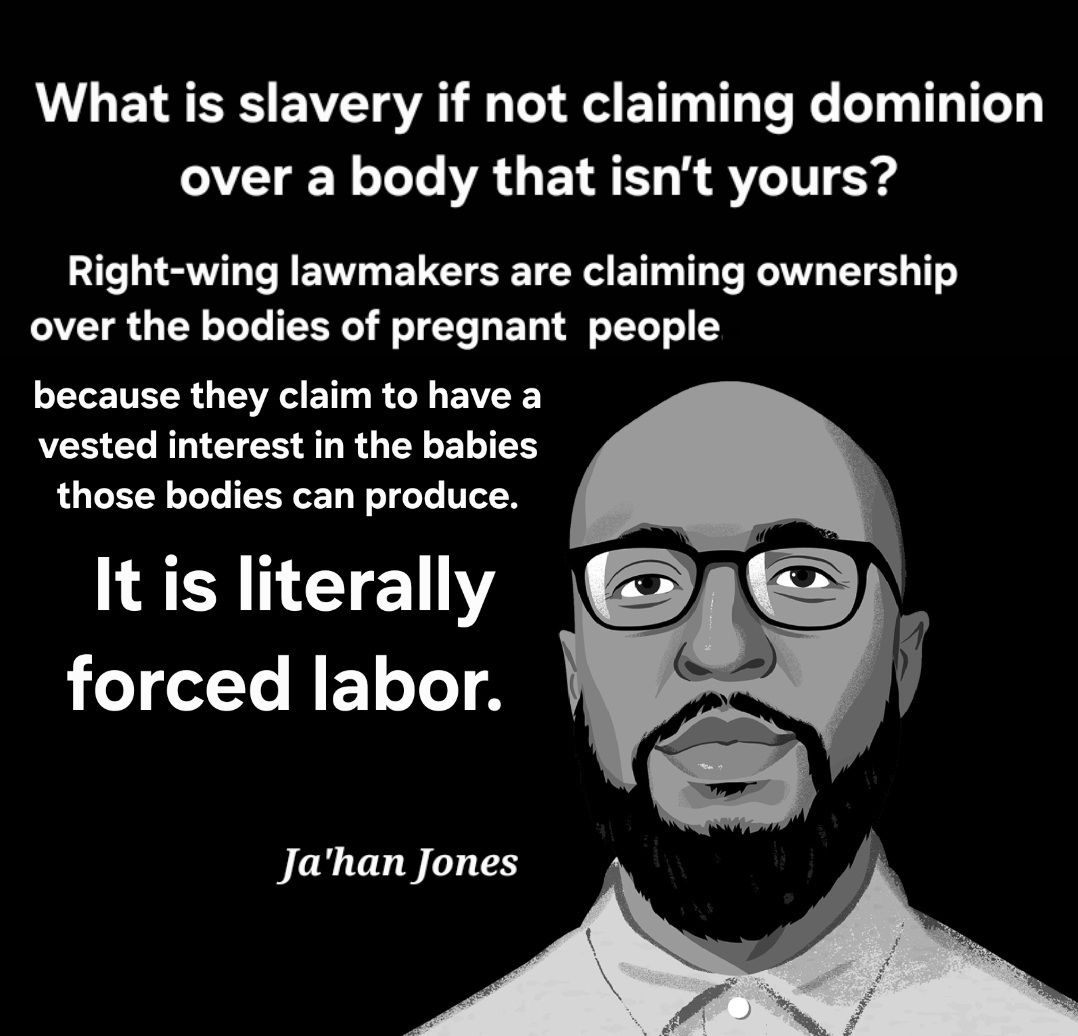
It was 2022. The Supreme Court’s decision in Dobbs v. Jackson Women’s Health Organization had just been released. Roe v. Wade had been overturned and a new, terrifying countdown had begun: Soon, all terminations of a pregnancy in Tennessee would be a felony—including those necessary to avert a patient's death. If I were to become pregnant, the State was going to keep me pregnant—even if it killed me.
With the overturning of Roe v. Wade and Tennessee’s trigger ban looming, a sudden and wholly unfamiliar feeling washed over me.
I felt owned.
Abruptly alienated both from my own body and from the beneficence of my own state, I felt as though I had been demoted from a person to State property, from human to thing.
If my body, my health, my future — even whether I lived or died — were all to be controlled by the government should I become pregnant, then my body, my health, my future, and even my life did not belong to me.
I didn't belong to me.
And I wasn't the only one feeling this way…

Ownership
The objectifier treats the object as something that is owned by another, or that can be bought or sold
Objectification via Ownership “is acted out when people control others’ freedom,” such as the freedom to make healthcare decisions, “presuming[] that control of others is their right.”2 “Countless anti-choice propaganda sends the message that women of reproductive age do not fully own their bodies.”3 Instead, those bodies are presented as belonging to men, to the fetus, and to the State.4

Shortly after the Dobbs decision, researchers conducted a study “to understand how the Dobbs ruling impacted the way women experience their bodies.” Participants told the researchers that “they felt as if their bodies were not their own.”5
For example, one of the study participants, a 25-year-old Black woman in Georgia, told researchers the following.
“The decision makes me feel like my body doesn’t belong to me. Like I’m a piece of property owned by the state. It makes me feel like I don’t matter at all.”6
Just as had I felt as though I had been demoted from a person to State property, one of the study participants said she felt that the Dobbs decision “reduced her to a lower moral status in the eyes of others.”7 Another participant in the study told researchers the following.
“[The Dobbs decision] makes me feel like a political prisoner trapped inside of a body of a milking cow on a lucrative dairy farm.”8
These and other quotes “illustrate the various ways that restricted access to abortion was experienced as objectifying and dehumanizing to participants.”9
Own
a) to have as one’s possession
b) to have control over
The Dobbs decision, at its core, is an act of usurpation: The Dobbs Court stripped the individual of power and then handed power over the individual to the State, to be wielded against the individual according to the State’s own whims.
The sudden loss of power, rightly belonging to individuals, to make private medical decisions for themselves — decisions that directly affect their health and wellbeing — caused many of the study participants to feel:
“less than human”;
“devoid of personal preferences and needs”;
“lacking control and ownership of their bodies and their future.”10
Participants in the study described experiencing their body as:
“a site of regulation and surveillance”;
“a site controlled by others, specifically by men and/or the government”;
a site of alienation, “as if their bodies were not their own.”11
“Participants described abortion access as fundamentally humanizing and shared that they felt that the overturning of Roe signified that the government did not see them as fully human. Several participants explicitly stated that they felt like an ‘object.’”12 “Others drew comparisons to specific types of objects as a way to describe how they were made to feel less than human.”13

Ownership
a) the act of having and controlling
b) right of possession
c) the relation of an owner to the thing possessed
Though often overlooked, scholars have pointed out that the notion that states have ownership of pregnant human beings — as if those human beings are mere things — is central to the Dobbs v. Jackson Women’s Health Organization case, beginning with the oral arguments at the Supreme Court.14
During oral arguments, “the Mississippi Solicitor General functionally argued that pregnant people are under the ownership of their state given that states should be able to make decisions for pregnant people ‘however [the state] thinks is best.’”15
When a group of people, based on a biological condition or trait—be it skin color, sex, or gravidity—is treated “as something that is owned by another,” then that group of people has been treated as an object, a mere thing.16 During oral arguments, when Mississippi insisted that the State should be handed the power to make healthcare decisions for every girl and woman in the state, so that the State of Mississippi could then wield that power over and against them “however the state thinks is best,” Mississippi was claiming a right of possession of the bodies of women and girls.
If you've made it this far, you're the kind of person who appreciates in-depth analysis. Please consider giving a few dollars today to support rePro-Truth or upgrade to a paid subscription. Thank you!

Objectification via Ownership
The objectifier sees and treats a person as property; as a possession; as a thing that is owned
The objectifier sees and treats a person as a thing that can be traded, bought, sold, and/or exploited for personal gain
It should not be surprising that the oral arguments in a case that ultimately brought asunder the national compromise that existed under Roe v. Wade featured a former Confederate state claiming a right of possession of and control over the bodies of human beings. As rePro-Truth previously noted in Abortion Bans Constitute Involuntary Servitude, “long before states began to ban abortion for free, White women in the latter half of the 19th century, abortion and contraception were already banned for enslaved women and girls,” because “forced reproductive labor was the backbone of hereditary chattel slavery in America.”
Forced reproductive labor under the American system of hereditary chattel slavery took objectification via Ownership to the extreme. Inexcusably, remnants of reproductive slavery persist to this day. “Anti-abortion laws in the former slaveholding states” for example, “perpetuate structures of slavery in the form of state control over the Black female body.”
In Resuscitating the Black Body, Black legal scholar Jill C. Morrison notes that, “Inasmuch as enslaved Africans were the property of their owners, the sexual and reproductive capacities of women were also owned. Women’s sexuality and reproduction merely reinforced their status as property.”17 “Current methods of reproductive oppression, in which the State holds property rights over Black women’s bodies through restrictive laws and policies, replicate what was once owners’ private property interest in their female slaves.”18
“Black women in the United States have always been burdened with advancing others’ priorities with regard to their reproductive decision-making.”19 Anti-abortion “discourse about Black women’s reproductive and sexual capacities is still influenced by the notion developed during enslavement that Black women’s reproductive labors are for the benefit of others; that they are the property of others, be it individual masters or the State acting as master.”20
“Current attempts to marginalize and objectify Black women vis-à-vis their reproductive capacities reflect this centuries-long history of oppression, and must be explicitly rejected on this basis.”21
“For in slavery her body is not only treated as an animal body but is property, to be ‘taken’ and used at will. Such a body is denied even the dignity accorded a wild animal; its status approaches that of mere matter, thinghood.”
— Susan Bordo, Unbearable Weight: Feminism, Western Culture and the Body
And don't forget that three states are trying to increase the teen birth rate in order to get more federal dollars and hold onto political power. Like total creepers.
As rePro-Truth reported, “The Plaintiff States’ argument here is functionally a slaver’s argument: A caste of humans must perform unpaid, involuntary labor so that the Master can maintain power and reap financial benefits.”

As rePro-Truth discussed in previous post in this series on objectification, Fungibility: Exchangeable Parents and the 'Domestic Supply of Infants,' Justice Samuel Alito, in his Dobbs opinion, brazenly claimed that no one needs an abortion anymore because those who States may now force into involuntary reproductive servitude can simply terminate their parental rights after birth. Easy peasy lemon squeezy!
Alito wrote, “a woman who puts her newborn up for adoption today has little reason to fear that the baby will not find a suitable home.”
To support these claims, Alito cited a 2008 CDC report. In the citation, Alito chose to include the following quotation from that report.
“[N]early 1 million women were seeking to adopt children in 2002 (i.e., they were in demand for a child), whereas the domestic supply of infants relinquished at birth or within the first month of life and available to be adopted had become virtually nonexistent.”22
Alito’s rhetoric in Dobbs, along with the CDC quote in the footnote, “assumes that families are fungible. It matters not what family a child is raised in — they are all interchangeable. Consider all the care we take at hospital nurseries to match parents and newborns — unnecessary in this worldview. We should parcel them out on a first-come, first-served basis!”23
“[W]ithin the capitalist math of supply and demand,” observes Peggy Phelan, forcing human beings into involuntary reproductive servitude by outlawing abortion will “solve the adoption ‘supply’ issue.”24 In this equation of family separation, infants exist as a product (Ownership) supplied for the enjoyment of prospective parents, and women exist to produce (see Instrumentality) a supply of infants for prospective parents.
Commodity
a) an article of trade or commerce
b) a good or service that is sold
Commodify
a) to turn into or treat as a commodity; make commercial
b) to treat (something) inappropriately as if it can be acquired or marketed like other commodities
Commodification
the process by which goods and services are increasingly produced for the market
The rhetoric and phrasing surrounding adoption and abortion that is used by opponents of reproductive health, rights, and justice, reflect objectification via Ownership, as pregnant individuals and their children are framed through an industrial supply-chain lens.
Implicit herein is the seeing and treating of babies as commodities and women as producers of a scarce resource. As legal scholar Sharon Bassan emphasizes:
“This implicit narrative, reinforced in the Dobbs opinion, works against contemporary liberal values that emphasize the importance of individual autonomy, equality, and the rejection of any form of dehumanization or commodification, because it objectifies and reduces women to property, valued only for its economic outcomes. This narrative diverts the focus from the child and their best interests, redirecting it toward the desires of prospective adoptive parents, with children being positioned as means to fulfill those desires.”25
In the anti-choice world of supply and demand—of objectification via Ownership—“adoption as a child welfare measure, where children without family are provided one,” instead “becomes an operation to produce children to satisfy the wants of prospective adoptive parents.”26 This is a gross inversion of what adoption ought to be. “There are social costs in the commodification of children in this manner.”27
“Babies are not choosing for themselves that under current nonideal circumstances they are better off as commodities… we commodify not only the mother’s (and father’s) baby-making capacities… but we also conceive of the baby itself in market rhetoric.”
—Margaret Jane Radin, Market-Inalienability
Nussbaum M. C. (1995). Objectification. Philosophy & Public Affairs, 24(4), 249–291. https://doi.org/10.1111/j.1088-4963.1995.tb00032.x
LaCrois, J. M., & Pratto, F. (2015). Instrumentality and the denial of personhood: The social psychology of objectifying others | cairn.info. CAIRN.INFO. https://shs.cairn.info/revue-internationale-de-psychologie-sociale-2015-1-page-183?lang=fr
Agostinone-Wilson, F. (2014). Fetal personhood: Social meanings and functions. Critical Education, 5(12), 15-39. Retrieved from http://ojs.library.ubc.ca/index.php/criticaled/article/view/184397
Agostinone-Wilson, F. (2014). Fetal personhood: Social meanings and functions. Critical Education, 5(12), 15-39. Retrieved from http://ojs.library.ubc.ca/index.php/criticaled/article/view/184397
Nolen, E., Siegel, J. A., Mendoza, R. R., Cubbin, C., Vohra-Gupta, S., Dosanjh, L. H., & Lewis- Smith, H. (2024). The impact of Dobbs v. Jackson Women’s Health Organization on young women’s experiences of objectification and sexual well-being. Psychology of Women Quarterly, 48(3), 319–334. https://doi.org/10.1177/03616843241238174
Nolen, E., Siegel, J. A., Mendoza, R. R., Cubbin, C., Vohra-Gupta, S., Dosanjh, L. H., & Lewis- Smith, H. (2024). The impact of Dobbs v. Jackson Women’s Health Organization on young women’s experiences of objectification and sexual well-being. Psychology of Women Quarterly, 48(3), 319–334. https://doi.org/10.1177/03616843241238174
Nolen, E., Siegel, J. A., Mendoza, R. R., Cubbin, C., Vohra-Gupta, S., Dosanjh, L. H., & Lewis- Smith, H. (2024). The impact of Dobbs v. Jackson Women’s Health Organization on young women’s experiences of objectification and sexual well-being. Psychology of Women Quarterly, 48(3), 319–334. https://doi.org/10.1177/03616843241238174
Nolen, E., Siegel, J. A., Mendoza, R. R., Cubbin, C., Vohra-Gupta, S., Dosanjh, L. H., & Lewis- Smith, H. (2024). The impact of Dobbs v. Jackson Women’s Health Organization on young women’s experiences of objectification and sexual well-being. Psychology of Women Quarterly, 48(3), 319–334. https://doi.org/10.1177/03616843241238174
Nolen, E., Siegel, J. A., Mendoza, R. R., Cubbin, C., Vohra-Gupta, S., Dosanjh, L. H., & Lewis- Smith, H. (2024). The impact of Dobbs v. Jackson Women’s Health Organization on young women’s experiences of objectification and sexual well-being. Psychology of Women Quarterly, 48(3), 319–334. https://doi.org/10.1177/03616843241238174
Nolen, E., Siegel, J. A., Mendoza, R. R., Cubbin, C., Vohra-Gupta, S., Dosanjh, L. H., & Lewis- Smith, H. (2024). The impact of Dobbs v. Jackson Women’s Health Organization on young women’s experiences of objectification and sexual well-being. Psychology of Women Quarterly, 48(3), 319–334. https://doi.org/10.1177/03616843241238174
Nolen, E., Siegel, J. A., Mendoza, R. R., Cubbin, C., Vohra-Gupta, S., Dosanjh, L. H., & Lewis- Smith, H. (2024). The impact of Dobbs v. Jackson Women’s Health Organization on young women’s experiences of objectification and sexual well-being. Psychology of Women Quarterly, 48(3), 319–334. https://doi.org/10.1177/03616843241238174
Nolen, E., Siegel, J. A., Mendoza, R. R., Cubbin, C., Vohra-Gupta, S., Dosanjh, L. H., & Lewis- Smith, H. (2024). The impact of Dobbs v. Jackson Women’s Health Organization on young women’s experiences of objectification and sexual well-being. Psychology of Women Quarterly, 48(3), 319–334. https://doi.org/10.1177/03616843241238174
Nolen, E., Siegel, J. A., Mendoza, R. R., Cubbin, C., Vohra-Gupta, S., Dosanjh, L. H., & Lewis- Smith, H. (2024). The impact of Dobbs v. Jackson Women’s Health Organization on young women’s experiences of objectification and sexual well-being. Psychology of Women Quarterly, 48(3), 319–334. https://doi.org/10.1177/03616843241238174
Dyer, R. L., Checkalski, O. R., & Gervais, S. J. (2023). Abortion Decisions as Humanizing Acts: The Application of Ambivalent Sexism and Objectification to Women-Centered Anti-Abortion Rhetoric. Psychology of Women Quarterly, 47(4), 528-546.
Dyer, R. L., Checkalski, O. R., & Gervais, S. J. (2023). Abortion Decisions as Humanizing Acts: The Application of Ambivalent Sexism and Objectification to Women-Centered Anti-Abortion Rhetoric. Psychology of Women Quarterly, 47(4), 528-546.
Nussbaum M. C. (1995). Objectification. Philosophy & Public Affairs, 24(4), 249–291. https://doi.org/10.1111/j.1088-4963.1995.tb00032.x
Jill C. Morrison, Resuscitating the Black Body: Reproductive Justice as Resistance to the State’s Property Interest in Black Women’s Reproductive Capacity, Yale Journal of Law and Feminism. https://openyls.law.yale.edu/entities/publication/6cbb8fb1-acb2-4541-b8ed-04ef3366b334
Jill C. Morrison, Resuscitating the Black Body: Reproductive Justice as Resistance to the State’s Property Interest in Black Women’s Reproductive Capacity, Yale Journal of Law and Feminism. https://openyls.law.yale.edu/entities/publication/6cbb8fb1-acb2-4541-b8ed-04ef3366b334
Jill C. Morrison, Resuscitating the Black Body: Reproductive Justice as Resistance to the State’s Property Interest in Black Women’s Reproductive Capacity, Yale Journal of Law and Feminism. https://openyls.law.yale.edu/entities/publication/6cbb8fb1-acb2-4541-b8ed-04ef3366b334
Jill C. Morrison, Resuscitating the Black Body: Reproductive Justice as Resistance to the State’s Property Interest in Black Women’s Reproductive Capacity, Yale Journal of Law and Feminism. https://openyls.law.yale.edu/entities/publication/6cbb8fb1-acb2-4541-b8ed-04ef3366b334
Jill C. Morrison, Resuscitating the Black Body: Reproductive Justice as Resistance to the State’s Property Interest in Black Women’s Reproductive Capacity, Yale Journal of Law and Feminism. https://openyls.law.yale.edu/entities/publication/6cbb8fb1-acb2-4541-b8ed-04ef3366b334
CDC, Adoption Experiences of Women and Men and Demand for Children To Adopt by Women 18–44 Years of Age in the United States 16 (Aug. 2008)
Malinda L. Seymore (2023), Social Costs of Dobbs’ Pro-Adoption Agenda, University of California, Davis. https://lawreview.law.ucdavis.edu/sites/g/files/dgvnsk15026/files/2023-11/57-1_Seymore.pdf
Phelan, P. (2022). The Dobbs Decision: Abortion, Adoption, and the Supreme Court. Adoption & Culture 10(2), 171-183. https://dx.doi.org/10.1353/ado.2022.0013.
Bassan, S. (2025). Recentering Women in Judicial Decisions on Reproductive Practices: U.S. and Israeli Case Studies. Columbia Journal of Gender and Law, 45(2), 173–240. https://doi.org/10.52214/cjgl.v45i2.13771
Malinda L. Seymore (2023), Social Costs of Dobbs’ Pro-Adoption Agenda, University of California, Davis. https://lawreview.law.ucdavis.edu/sites/g/files/dgvnsk15026/files/2023-11/57-1_Seymore.pdf
Malinda L. Seymore (2023), Social Costs of Dobbs’ Pro-Adoption Agenda, University of California, Davis. https://lawreview.law.ucdavis.edu/sites/g/files/dgvnsk15026/files/2023-11/57-1_Seymore.pdf