

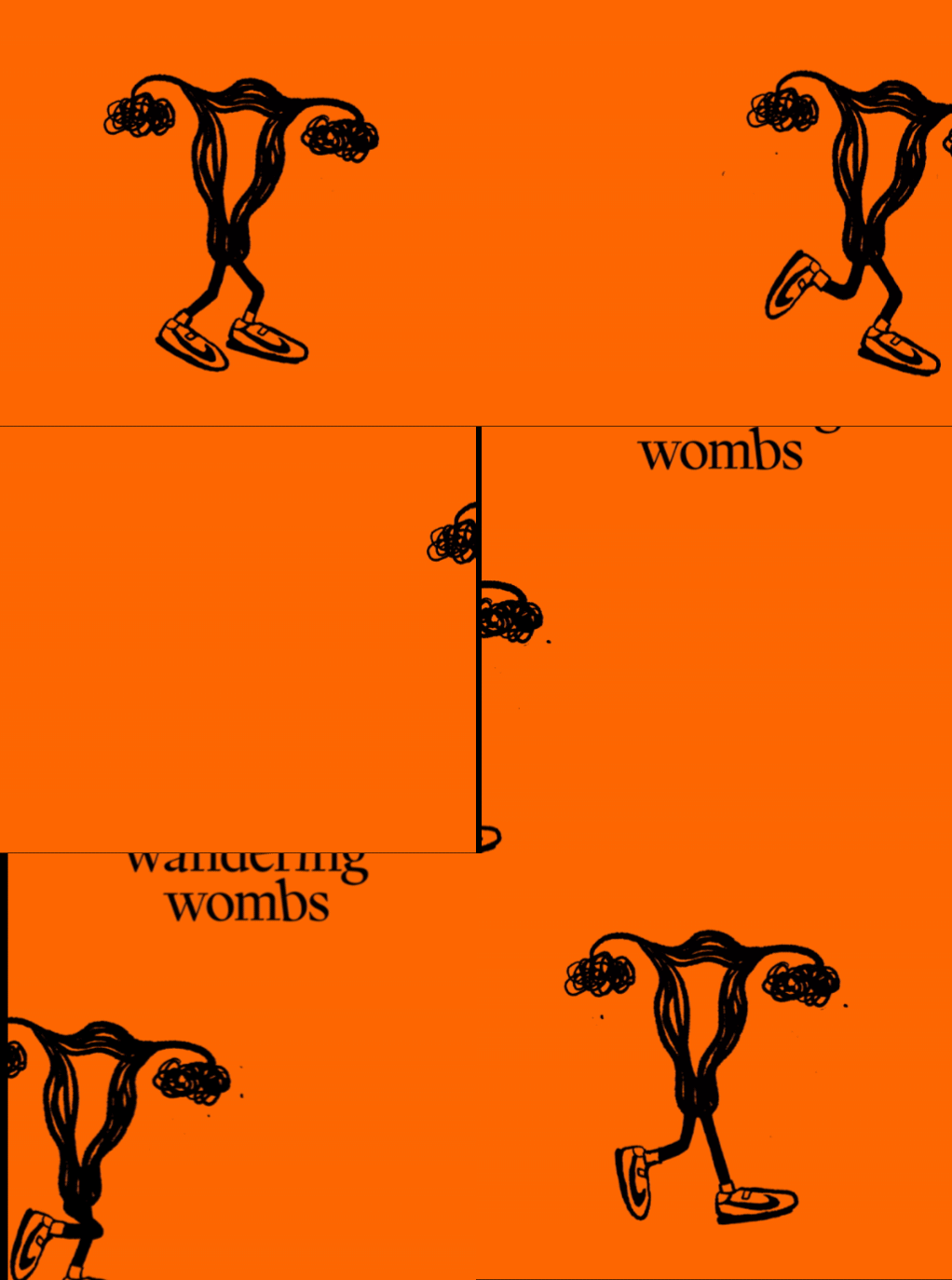
“What is a woman? ‘Tota mulier in utero: she is a womb,’ some say.”
— Simone de Beauvoir
We've all heard people (often men) refer to women as tits and ass or a piece of ass, reducing women to body parts that exist for the use and pleasure of others. Referring to a person as womb is no different. Both constitute objectification via Reduction to Body.
“At its core, objectification encompasses beliefs that it is acceptable to use someone’s body for another’s benefit, to reduce them to their physical body, and to deny their thoughts, feelings, and consent.”1
Scholars have identified at least ten ways of objectifying others—that is, of treating persons as mere things. This series discusses each.

Reduction to Body
The objectifier treats the object as identified with its body, or body parts.
Amicus briefs (“friend-of-the-court” briefs) are filed by individuals, groups, or organizations who have a strong interest in the subject and outcome of a particular court case but who are not themselves a party to or directly involved in litigating that case. Amicus briefs are submitted to the court presiding over a case in hopes of influencing the court's decision.
In a 2024 study, researchers examined the language used in amicus briefs submitted to the Supreme Court in the milestone abortion cases of Roe v. Wade, Doe v. Bolton, Planned Parenthood v. Casey, and Dobbs v. Jackson Women’s Health Organization—spanning a fifty year time period. Researchers discovered that, over time, the briefs submitted by those wishing to curtail bodily autonomy, medical privacy, and abortion access “increasingly referred to pregnant people by smaller, segmented, anatomical parts (e.g., womb).”2 In so doing, these briefs “isolated the womb as the entirety of the pregnant person.”3
Synecdoche:
a figure of speech where a part of something stands for the whole
Womb as synecdoche:
a person's entire identity, personhood, and value is reduced to just their reproductive capacity or organ
The researchers also observed a notable overuse of grammatical structures containing womb within briefs submitted by conservative religious entities. This overuse, the researchers note, advanced the amici's fetal personhood agenda by “removing the pregnant person from the writing and analysis.”4 Through “the complete erasure of the pregnant woman,” the womb “became an abstract site disconnected from the human actor”; doing so “foregrounded a fetal-centered analysis that conveniently ignored the physiological relationship of the womb to the pregnant person and only situated the fetus in or out of the womb.”5
The “usage of items like womb” within the amicus briefs submitted by those wishing to curtail bodily autonomy, privacy, and abortion access, “described the fetal environment, effectively removing the woman and her labor from the discussion.”6
Reduction to Body:
the objectifier sees and/or treats a human person as nothing or little over and above a body or a body part(s); and/or
the objectifier foregrounds a person's body or body parts or sexual/reproductive functions.
We've all heard people (often men) objectify women by referring to them as tits and ass or a piece of ass. Referring to a person as womb is no different. — Both constitute objectification via Reduction to Body.
This “occurs whenever a woman’s body, body parts, or sexual [or reproductive] functions are separated out from her person, reduced to the status of mere instruments, or regarded as if they were capable of representing her.”7 Hence, “when objectified, women are treated as bodies—and in particular, as bodies that exist for the use and pleasure of others.”8
In the context of pregnancy, Reduction to Body is part of what scholars refer to as reproductive objectification.
Researchers note that “pregnant people, and especially women, may experience a specific form of sexual objectification grounded in reproductive function, namely reproductive objectification. As a form of sexual objectification, reproductive objectification reduces pregnant women to their bodies while denying their personhood and deprioritizing their autonomy, subjectivity, and voice; it is tied to using women… for sexual reproduction” while “prioritizing others’ interests (e.g., fetuses, medical providers, and society) over women’s interests” and wellbeing.9
Reproductive objectification via Reduction to Body occurrs when “the physical body and functions are separated out from the person as a whole and treated as if they represent the person. In other words, a complex and multifaceted individual is considered and treated solely as a physical body” that exists to be used by others and for others.10
In the 2024 study discussed above, researchers found that, within the amicus briefs submitted in support of curtailing bodily autonomy, medical privacy, and abortion access, pregnant people were referred to as womb with high frequency (787.23/million words) — reducing human beings to a fetal-centric environment and existing for the use and pleasure of others.
Pregnant persons’ worth, value, and identity were reduced to an anatomical body part, stripping them of their humanity—of personality, individuality, competency, and intrinsic value. As the researchers observed, this “effectively removed[] the woman and her labor from the discussion.”11
Once rendered invisible, a pregnant person is no longer comprehended as a full human being deserving of moral treatment from others—the objectified womb-person's wishes, needs, health, life, and dreams are given no consideration.
‘At its core, objectification encompasses beliefs that it is acceptable to use someone’s body for another’s benefit, to reduce them to their physical body, and to deny their thoughts, feelings, and consent.’
Referring to a human person as tits and ass or womb isn't the only way people are objectified by being reduced to their bodies. Imagery, linguistic forgrounding, as well as ingrained and unexamined cultural expectations can reduce a human being to a mere body or pody part(s).
Let's Dig Deeper…
(Note: rePro-Truth's couldn't keep going and growing without the support of paid subscribers. In appreciation, Let's Dig Deeper is additional content available to those subscribers.)
Groups that are opposed to bodily autonomy, medical privacy, and reproductive rights and justice frequently reduce pregnant persons to womb or to a mere body. Consider the following two “Pro-Life” memes.
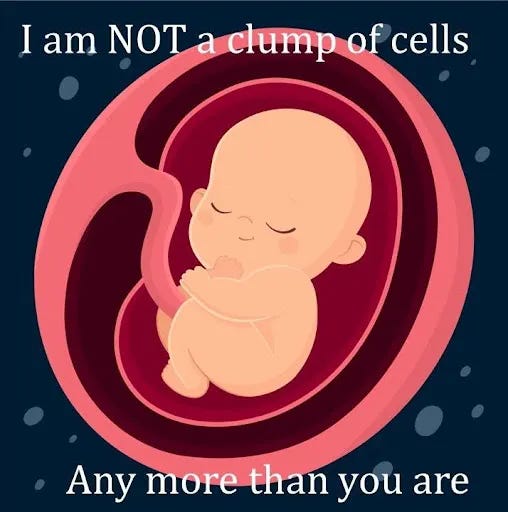
In the above image, we find a fetus personified as born infant: smiling, chubby, and cuddly, with rosie cheeks. The fetus is floating within a dark pink circle, the uterus, and is connected to it by the umbilical cord. The uterus appears to be floating underwater, surrounded by bubbles. Hence, what we see is a happy, chubby, fetus-baby happily floating along through the sea in it pink container — like a little message in a bottle soon to arrive upon shore where a smiling mommy and daddy wait for it.
Here, the disembodied uterus is an abstract site disconnected from the pregnant human being.
